The Paradox of Social Media & Algorithm of Brain | How Social Media Controls Our Behavior.
Learn to understand how social media algorithms influence dopamine, attention, emotions, and mental health—and how to take back control of your digital habits.
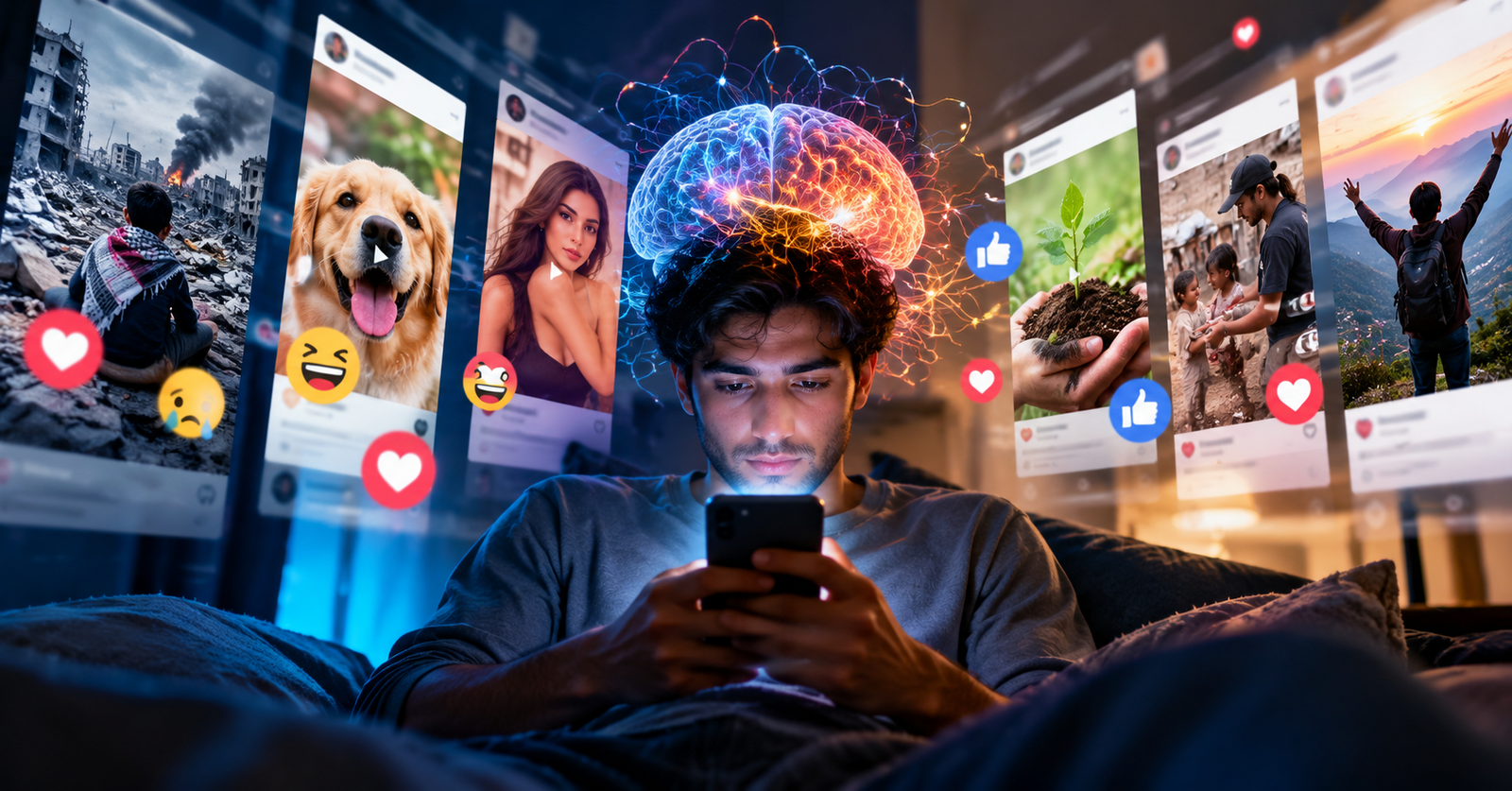
The Apps That Connect Us Can Also Consume Us
You see a protest or footage of a genocide on Instagram. You feel sad, angry, and helpless. You think you should support the victims, so you share the post.
A few seconds later, you scroll past a funny video and burst out laughing. Another swipe, and you encounter an erotic video that you share with a friend. Moments later, you see a social issue, feel outraged, and repost it with a caption demanding change.
All of this happens within a few minutes. Your emotions shift from sadness to amusement, from desire to anger, and from sympathy to a sense of responsibility.
Now, pause and think.
Did you genuinely intend to engage with all this content before opening the app? Did you consciously decide how you would respond to each post? And beyond reacting, sharing, and reposting, did you actually participate in any of the causes you supported?
Your reactions were counted. Your likes, shares, comments, and reposts became measurable signals of engagement. But what happened to your attention in the process?
In just a few minutes, your mind was pulled through a series of emotional states without having enough time to reflect on any one of them. You felt something, reacted,
You open Instagram to reply to a message. A few minutes later, you are watching a stranger's morning routine, comparing your progress with someone else's success, reading an argument between people you have never met, and wondering why you feel strangely dissatisfied.
You put your phone down, only to pick it up again moments later.
Sound familiar?
Social media was built around a powerful idea: bringing people closer together. It allows us to maintain relationships, discover new ideas, learn useful skills, and share experiences across geographical boundaries. Yet the same platforms that promise connection can leave us distracted, emotionally exhausted, and increasingly dependent on digital validation.
What explains this contradiction?
Part of the answer lies in the relationship between the human brain and the algorithms that decide what appears on our screens.
Modern social media platforms do not simply display posts in chronological order. Their recommendation systems learn from our behaviour, predict what might interest us, and continually adjust our feeds. The result is a highly personalised stream of content that can influence what captures our attention, how we feel, and what we choose to do next.
The paradox is that the more personalised our digital world becomes, the easier it can be to lose sight of the world beyond it.
Understanding this relationship does not require us to abandon technology. It requires us to understand the psychological mechanisms behind our digital habits—and to recognise when a tool designed to serve us begins to command our attention.
1. How Social Media Algorithms Learn What Keeps Us Watching
Every like, comment, share, pause, replay, search, and scroll can provide information about our interests.
Recommendation algorithms use different combinations of these signals to estimate which content a user is likely to watch, enjoy, or interact with. The precise systems vary across platforms, but the general principle is similar: previous behaviour helps predict future engagement.
Imagine watching a short video about productivity. You watch another one, save a third, and pause on a fourth. Over time, the recommendation system may begin showing you more productivity content.
Initially, this can be useful. You discover relevant advice without having to search for it.
But suppose the content gradually shifts from practical advice to extreme routines, unrealistic success stories, and videos suggesting that you are falling behind in life. Your feed may continue to show similar material because your behaviour signals interest, even if that interest comes from anxiety, frustration, or curiosity rather than genuine enjoyment.
This reveals an important distinction: an algorithm can interpret attention without fully understanding why you are giving it.
A person may watch a distressing video because it is upsetting, not because it improves their well-being. Someone may repeatedly check a profile because they feel insecure, not because the experience makes them happy.
Engagement is measurable. Emotional benefit is much harder to measure.
Research examining digital media algorithms has raised concerns about how engagement-based systems may amplify emotionally charged material, reinforce existing interests, and shape the information people encounter. However, the effects vary, and the available evidence does not establish that every personalised feed causes psychological harm.
The deeper question is whether a system optimised to predict our next interaction necessarily serves our long-term interests.
2. The Brain's Reward System: Why We Keep Checking Our Phones
Why can a notification feel irresistible? Why do we sometimes check our phones without consciously deciding to do so?
One explanation involves the brain's reward-learning systems.
Dopamine is a neurotransmitter involved in motivation, learning, and the processing of rewards and reward-predicting cues. It is often described as the brain's pleasure chemical, but that description is incomplete. Dopamine also helps the brain learn which actions may lead to rewarding outcomes.
Social media offers many possible rewards: an unexpected message, a new follower, a positive comment, an entertaining video, or a post that makes us feel understood.
The uncertainty surrounding these rewards can make checking particularly tempting.
You might open an app and find nothing interesting. A moment later, you receive a message from a friend. On another occasion, a post receives far more attention than expected. Because the outcome is not always predictable, checking again can feel worthwhile.
This resembles a broader psychological principle known as intermittent reinforcement: a behaviour can become persistent when rewards arrive unpredictably rather than every time.
Social media is not identical to gambling, and the presence of dopamine does not prove that someone is addicted. Nevertheless, unpredictable feedback, notifications, and constantly refreshed content can encourage repeated checking.
The cycle of digital reward
A common pattern looks like this:
Cue: A notification appears, or you remember an app.
Anticipation: You wonder whether something interesting has happened.
Action: You open the app and scroll.
Reward or relief: You find a message, entertaining content, or temporary relief from boredom.
Repetition: The experience makes checking again more likely in a similar situation.
Over time, this pattern may become habitual.
You might reach for your phone whenever you feel bored, uncomfortable, lonely, or uncertain. Eventually, the action can occur before you have consciously considered whether you actually want to use the app.
The concern is not that every notification damages the brain. It is that repeated, automatic checking can gradually take time and attention away from activities that require sustained effort.
3. The Attention Paradox: Endless Content, Limited Concentration
Attention is a limited resource. It allows us to focus on a task, ignore distractions, retain information, and work towards goals that may take time to achieve.
Social media presents a competing environment: short videos, rapid transitions, new notifications, and an effectively endless supply of content.
Each item offers the possibility of something more interesting just one swipe away.
This can encourage frequent shifts in attention. When a person repeatedly interrupts reading, studying, or working to check a feed, they must repeatedly redirect their focus to the original task.
The cost is not always obvious. A quick glance at a notification may take only seconds, but returning to a demanding task can require additional mental effort.
It is worth making a distinction here: there is not enough evidence to conclude that ordinary social media use permanently damages everyone's attention span. Research findings depend on the type of use, individual differences, age, and how attention is measured.
Still, the practical concern is clear. A habit of responding to every digital interruption can make sustained concentration more difficult to maintain.
Why silence can start to feel uncomfortable
When we become accustomed to constant stimulation, ordinary moments may seem unusually dull.
Waiting in a queue, sitting alone, travelling without music, or eating without a screen can begin to feel like wasted time.
Yet these quiet intervals can give us room to reflect, process emotions, observe our surroundings, and allow thoughts to develop without interruption.
If every pause is filled with content, we lose opportunities to practise being comfortable without stimulation.
The goal is not to romanticise boredom. It is to recognise that our minds need more than continuous entertainment.
4. The Social Comparison Trap: When Someone Else's Life Becomes Your Benchmark
Social media offers an unusual window into other people's lives. We see their holidays, achievements, relationships, fitness progress, celebrations, and professional milestones.
But these glimpses are rarely complete representations of reality.
People tend to share moments they consider worth showing. Photographs may be carefully selected, edited, staged, or captured after many attempts. Financial difficulties, private conflicts, failed projects, and ordinary frustrations often remain invisible.
The result is an uneven comparison: we evaluate our complete lives against selected moments from someone else's.
A student may compare their ordinary day with a creator's highlight reel. A professional may feel unsuccessful after seeing another person's promotion. Someone struggling with their appearance may spend hours looking at edited photographs and carefully constructed beauty standards.
Even when we intellectually understand that social media is selective, repeated exposure can still influence our expectations.
Research on social media and psychological well-being has explored links involving social comparison, body image, self-esteem, anxiety, and depressive symptoms. The strength and direction of these relationships vary between individuals and contexts.
The issue is not simply that other people appear successful. It is that personalised recommendation systems can repeatedly expose us to the same standards, making them seem more common or more necessary than they really are.
When comparison becomes part of identity
Repeated comparison can change the questions we ask ourselves.
Instead of asking, "Am I making progress?", we begin asking, "Am I progressing as quickly as everyone else?"
Instead of asking, "Do I like how I look?", we ask, "Would this photograph receive enough approval?"
Instead of enjoying an experience, we may start thinking about how it will appear online.
This shifts attention away from personal values and towards external evaluation.
Social media can also provide encouragement, community, representation, and support. The same platform that fuels comparison for one person may help another find people who understand their experiences.
Context matters. The aim is to notice whether our online interactions strengthen our sense of self or repeatedly undermine it.
5. Emotional Algorithms: Why Your Feed Can Start Reflecting Your Worst Mood
Have you noticed that when you begin watching a particular type of content, more of it seems to appear?
This can happen because recommendation systems use behavioural signals to predict what you may engage with next.
Now consider the role of emotion.
You feel anxious and watch a video about a worrying event. You watch another because it promises an explanation. You continue because the next video introduces a new threat or controversy.
The system may interpret your viewing behaviour as evidence of interest. It may then recommend related material, creating a cycle in which your emotional state influences your viewing and your viewing environment influences your emotional state.
Researchers have described related patterns as feedback loops between users' moods, online behaviour, and algorithmically recommended content.
This does not mean algorithms can read your mind or directly determine your emotions. Rather, they can respond to behavioural patterns that sometimes reflect an emotional state.
How negative feedback loops can develop
A possible cycle looks like this:
You feel worried, lonely, angry, or dissatisfied.
You seek content related to that feeling.
The recommendation system identifies patterns in your engagement.
Similar content appears more frequently.
Repeated exposure reinforces your attention towards the same concerns.
You continue engaging with the topic, and the cycle persists.
A similar pattern can develop around positive interests, such as learning a language, finding a supportive community, or building healthy habits.
That is why personalisation is not inherently harmful. Its effects depend partly on what it reinforces, how the content is presented, and how the person responds.
The concern arises when a feed repeatedly returns us to material that increases distress, encourages hostility, or narrows our perspective.
Sometimes the most useful response is not to keep asking why we feel bad. It is to examine the information environment we repeatedly expose ourselves to.
6. The Mental Health Question: Is Social Media Making Us Depressed?
The relationship between social media and mental health is more complicated than a simple yes-or-no answer.
Studies have reported associations between certain patterns of social media use and psychological difficulties, including anxiety, depressive symptoms, loneliness, sleep disruption, and body-image concerns. Other research has found small, mixed, or context-dependent effects.
Correlation alone does not establish causation.
For example, a person who feels lonely may turn to social media more often. Their existing loneliness may influence their online behaviour, rather than social media being the sole cause of that loneliness. In other cases, harmful online experiences may contribute to distress. Both processes can occur.
The design of the platform also matters. Passive comparison, cyberbullying, compulsive checking, and repeated exposure to distressing content are different experiences from meaningful conversations with friends or participation in a supportive community.
Age and personal circumstances matter as well. Adolescents may be particularly sensitive to peer feedback and social acceptance while still developing emotional regulation and decision-making skills.
A 2025 scoping review of social media and youth mental health examined platform features and policy recommendations, including the possible implications of recommendation systems and highly engaging interface design. Other academic work has explored how digital environments may shape reward learning, expectations, and emotional responses.
These findings support a more precise question than whether social media is universally good or bad:
What type of content are we consuming, why are we consuming it, how is it being delivered, and what effect is it having on our lives?
Warning signs worth paying attention to
Consider reviewing your habits if you regularly notice that:
You feel worse about yourself after scrolling.
You struggle to stop using an app even when you want to.
You compare your appearance, income, relationships, or achievements with people online.
Your sleep or work is repeatedly interrupted by social media.
You feel anxious when you cannot check notifications.
You spend more time consuming content than maintaining relationships or activities that matter to you.
You repeatedly watch material that leaves you angry, frightened, or emotionally drained.
These signs do not automatically indicate a mental health condition or an addiction. They can, however, suggest that your current digital habits deserve attention.
7. The Hidden Cost of Constant Connectivity
The paradox of social media extends beyond individual emotions.
We can be connected to hundreds of people and still feel disconnected from the person sitting beside us. We can spend hours consuming information and struggle to remember what we learned. We can document an experience so thoroughly that we pay less attention to experiencing it.
Constant connectivity can also blur the boundaries between work, rest, and personal relationships.
A notification during dinner becomes a reason to check an app. A short break becomes an extended scrolling session. A late-night conversation turns into another hour of videos, delaying sleep.
Sleep deserves particular attention. Using social media late at night can postpone bedtime, increase mental stimulation, and expose us to emotionally engaging material when we need to wind down. These effects may contribute to tiredness and difficulty concentrating the following day.
The solution is not to reject all digital communication. It is to protect the spaces in which attention, rest, and human connection need room to exist.
A conversation without a phone on the table, a walk without constant notifications, or an uninterrupted hour of work may seem ordinary. But these experiences allow us to direct our attention deliberately instead of responding to every new stimulus.
8. How to Take Back Control of Your Digital Habits
You do not need to delete every social media account to build a healthier relationship with technology. A more useful starting point is to change the conditions under which you use it.
1. Turn off non-essential notifications
Keep alerts for important people and practical responsibilities. Disable notifications that repeatedly invite you back into an app without offering anything you genuinely need.
This reduces the number of external cues competing for your attention.
2. Create a reason before opening an app
Before tapping an icon, ask yourself: "What am I here to do?"
Perhaps you want to reply to a message, publish a post, check a specific update, or learn something. Complete that task and leave when you are finished.
Having a clear purpose can interrupt automatic scrolling.
3. Train your feed through deliberate choices
Recommendation systems learn from behavioural signals, so your interactions can influence what appears over time.
Try these actions:
Unfollow accounts that repeatedly trigger unhealthy comparison.
Use "Not interested" or similar feedback options when available.
Avoid lingering on material you do not want to see more often.
Follow sources that teach useful skills, provide reliable information, or support your interests.
Search intentionally for topics you want to learn about rather than relying entirely on recommendations.
These steps will not completely control a platform's algorithm, but they can help shape your content environment.
4. Protect uninterrupted periods
Set aside periods for reading, studying, working, exercising, and spending time with family without checking social media.
Start with a manageable interval, such as 25 or 30 minutes, and extend it when it feels practical.
The purpose is to practise directing attention towards one activity without repeatedly switching tasks.
5. Keep your phone away from bedtime
Choose a consistent time to stop scrolling before sleep. Charge your phone away from your bed if practical, and use a separate alarm clock if checking your phone first thing in the morning has become habitual.
Protecting sleep may be more beneficial than simply trying to reduce a daily screen-time total.
6. Make room for offline rewards
Call a friend. Exercise. Read a book. Learn a skill. Spend time outdoors. Work on a project that produces something you can see, use, or share.
These activities offer forms of satisfaction that do not depend entirely on likes, views, or digital approval.
The goal is not to eliminate online enjoyment. It is to ensure that online activities do not crowd out other sources of meaning and satisfaction.
7. Review how you feel, not just how long you scroll
Screen-time statistics can reveal useful patterns, but duration alone does not tell the whole story.
Ask yourself:
Do I feel calmer or more agitated after using this app?
Did I choose to spend this time online, or did I drift into it?
Did I learn something, connect with someone, or accomplish a task?
Did my use interfere with sleep, work, or relationships?
These questions help distinguish purposeful use from habits that no longer serve you.
8. Seek support when necessary
If your social media use is persistently affecting your sleep, relationships, work, or emotional well-being, consider discussing it with a qualified mental health professional.
You do not have to wait until a problem becomes severe to ask for help.
9. The Responsibility Does Not Belong to Users Alone
It is easy to tell people to develop more discipline. Personal boundaries matter, but individual willpower cannot address every issue associated with platform design.
Recommendation systems operate within commercial environments where attention and engagement often have economic value. Features such as infinite scrolling, autoplay, personalised notifications, and highly responsive feeds can make it easier to continue using an app longer than intended.
This raises questions about how platforms should balance engagement with user well-being.
Should people have clearer explanations of why content is recommended? Should they have more control over recommendation settings? Should younger users receive stronger protections against harmful content and manipulative design? How can platforms assess whether their systems repeatedly expose vulnerable users to distressing material?
These questions require participation from technology companies, researchers, educators, regulators, parents, and users themselves.
Digital literacy should therefore extend beyond knowing how to use an app. It should include understanding how recommendation systems work, how online content can distort perceptions of reality, and how commercial incentives may influence the digital experiences we receive.
A healthier digital environment requires both informed users and responsible platform design.
10. The Real Paradox: We Use Algorithms, but They Also Shape Us
Social media is neither a neutral window into reality nor an inherently harmful technology.
It can help people discover communities, access education, maintain relationships, express creativity, and find support during difficult periods. It can also encourage repetitive checking, amplify emotional content, promote unrealistic comparisons, and fragment attention when its features interact poorly with our needs.
The paradox is that personalisation can make technology more useful while also making it more difficult to step away. The same feedback mechanisms that help us discover valuable information can repeatedly direct us towards content that captures our attention without improving our lives.
Our brains are built to learn from rewards, notice social signals, seek information, and respond to uncertainty. These tendencies are not personal weaknesses. They are part of how humans learn and interact with the world.
But when digital environments continuously activate these tendencies, we need to become more deliberate about the habits we develop.
The answer is not to fear algorithms or assume that every minute online is harmful. It is to question whether the way we use technology reflects our priorities.
Conclusion: Put Your Attention Back in Your Own Hands
The next time you open a social media app, pause for a moment.
Are you looking for a particular piece of information? Do you want to connect with someone? Are you taking a break, or are you avoiding something uncomfortable? And when you finish scrolling, do you feel that the experience was worth your time?
These small questions can help turn automatic behaviour into conscious choice.
You may not be able to see every factor influencing your feed, and you cannot control every decision a platform makes. But you can establish boundaries, change what you engage with, protect your sleep, and make room for experiences that exist beyond a screen.
Social media should help you connect with the world, not convince you that the world is limited to what appears on your feed.
The most important algorithm to understand is not just the one recommending your next video. It is the pattern of habits, expectations, and attention that develops through your repeated choices.
Technology will continue to become more personalised. The challenge is to make sure that, as our digital environments learn more about us, we do not lose sight of what matters to us.
Frequently Asked Questions
1. How do social media algorithms affect the brain?
Social media recommendation systems can influence the content people encounter and the frequency of exposure. Features involving unpredictable rewards, notifications, and continuous scrolling may reinforce repeated checking and affect how people allocate their attention. The effects differ by individual and pattern of use.
2. Does social media release dopamine?
Social interactions, rewarding feedback, and anticipation can involve the brain's dopamine-related learning and motivation systems. However, it is misleading to suggest that every like or notification produces a simple dopamine surge or that dopamine alone explains social media habits.
3. Can social media algorithms cause depression?
Current research does not establish that social media algorithms alone cause depression in every user. Certain patterns of use and online experiences have been associated with depressive symptoms, anxiety, and reduced well-being. The relationship can be influenced by existing mental health, age, social circumstances, content, and platform design.
4. Why is it so difficult to stop scrolling?
Endless feeds, autoplay, notifications, personalised recommendations, and unpredictable rewards can encourage continued engagement. Scrolling can also become a habit associated with boredom, stress, loneliness, or the desire for temporary relief.
5. How can I reduce the negative effects of social media?
Disable unnecessary notifications, set boundaries around app use, curate your feed, protect your sleep, take regular breaks, and pay attention to how you feel after using a platform. Focus on purposeful use rather than screen-time reduction alone.
6. Is social media always bad for mental health?
No. Social media can support friendships, learning, creativity, identity, and access to supportive communities. Its effects depend on the person, the content, the context, and the way the platform is used.
- social media
- Algorithm
- brain