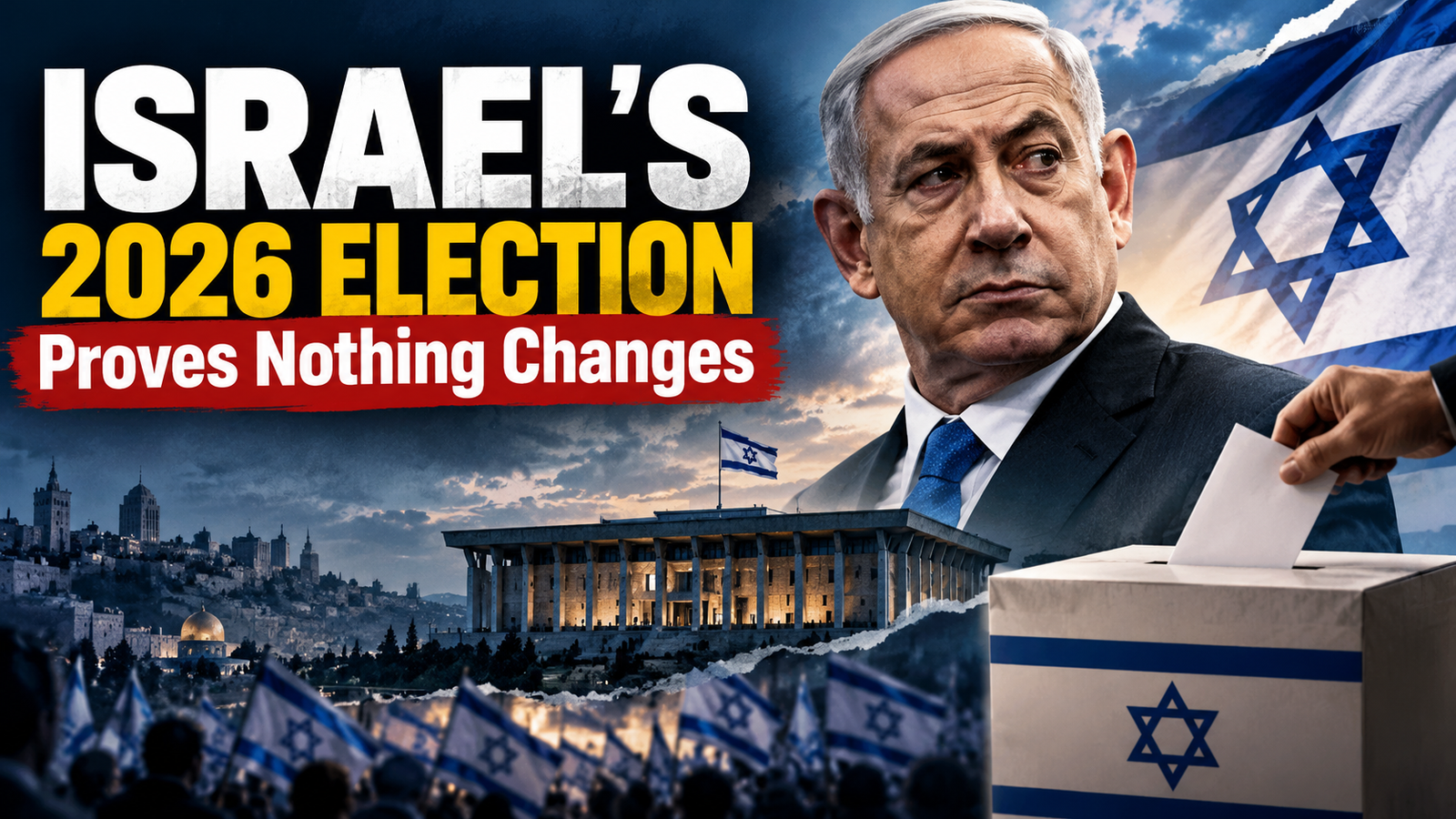
Israel's 2026 Election | END of Benjamin Netanyahu But???
Netanyahu is explicit: "We are going to fulfill our promise that there will be no Palestinian state." Eisenkot, the opposition leader, calls the two-state solution "a mistake." Smotrich wants to cancel the Oslo Accords. Ben-Gvir proposed "Disengagement 710"—moving 1.86 million Palestinians out of Gaza.
Why This Matters
People keep saying—"Well, at least Netanyahu might lose the 2026 election. Maybe things will change. Maybe a new government will be different."
They won't. Here's why, with documentation by bloglly.
The October 2026 Israeli Election: A Change That Changes Nothing
In October 2026, Israelis went to the polls. The results were messy, contested, and ultimately predictable. No clear winner. Netanyahu's bloc came out with roughly 53 seats. The opposition, led by Gadi Eisenkot, got around 48 seats. Smaller parties held the balance of power—which is where things get interesting, because it shows exactly what "change" actually means in Israeli politics.
The coverage made it sound like something shifted. Like Netanyahu's removal would mean a fundamental reckoning. A new direction. Accountability.
That's not what happened.
What the Winning Parties Actually Said About Palestine
Benjamin Netanyahu (Likud) — Explicit Rejection of Palestinian Statehood
Netanyahu's position has never been subtle. During the 2026 campaign, he was explicit: "We are going to fulfill our promise that there will be no Palestinian state; this place belongs to us."
That's not campaign rhetoric. That's a stated intention. A promise to his base, which means a commitment to policy. No Palestinian state. Full stop.
SOURCE: Al Jazeera - Israel's election: The main issues in the words of the leading candidates
Gadi Eisenkot (Yashar Opposition) — Not Actually Different
So the opposition might take power. That's progress, right? Eisenkot could be the alternative.
Except Eisenkot explicitly opposes the two-state solution. He called it "a mistake." Not a phrase you use when you're considering a policy. That's how you dismiss something entirely.
SOURCE: Al Jazeera - Israel's election: The main issues in the words of the leading candidates
Bezalel Smotrich (Religious Zionist Party) — Zionist Expansion
Then there's Smotrich. His position isn't negotiation. It's transformation. He wants to:
Cancel the Oslo Accords
Destroy what he calls "the idea of an Arab terror state"
Support "encouraging Palestinian emigration" from Gaza and the West Bank
That last point—"encouraging emigration"—is ethnic displacement dressed up in neutral language. And in 2026, Smotrich remained influential. Not sidelined. Influential.
SOURCE: Al Jazeera - Israel's election: The main issues
Itamar Ben-Gvir (Otzma Yehudit) — Far-Right and Growing
Ben-Gvir's Otzma Yehudit party has one platform position: opposition to Palestinian statehood. But it's not just opposition. It's replacement.
Ben-Gvir proposed "Disengagement 710"—a plan that would encourage Palestinians to leave Gaza. The numbers are staggering: 250,000 people in the first year, 1.86 million over seven years. That's not policy. That's demographic transformation.
In September 2026, before the election, he was already floating this. Not as a fringe idea. As a serious proposal.
SOURCE: Jerusalem Post - Israel Election 2026: What does Itamar Ben-Gvir's Otzma Yehudit stand for?
Naftali Bennett — Opposition Doesn't Mean Pro-Palestine
Bennett led an attempt to unseat Netanyahu, framed as opposition. But he also opposes Palestinian statehood. He just doesn't say it as loudly as Ben-Gvir or Smotrich.
The framing matters. Bennett gets described as "moderate" in some outlets. He's not. He's right-wing Zionist. The difference is tone, not substance.
SOURCE: Al Jazeera - If Netanyahu goes, does anything really change for Palestinians?
Yair Golan (The Democrats) — The Sole Exception
The Democrats, led by Yair Golan, is the only major party that even talks about a two-state solution. But here's what he actually said: it's "currently impossible" given Israeli trauma from October 7. His alternative? "Civil separation and security responsibility."
That's not a two-state solution. That's a different framework entirely—one where Israel maintains control, Palestinians get... something less.
SOURCE: Al Jazeera - Israel's election: The main issues in the words of the leading candidates
The Uncomfortable Truth: All Zionist Parties Reject Palestinian Statehood
Here's what no one wants to say clearly: all the Zionist parties—from Netanyahu's right to the supposed opposition—reject Palestinian statehood.
Not some of them. All of them.
DIRECT QUOTE: "All Zionist parties, from far right to the remaining Zionist 'left,' reject a Palestinian state."
That's not an opinion. That's the observable fact of Israeli electoral politics in 2026.
The choice between Netanyahu and Eisenkot isn't a choice between support for Palestinian statehood and opposition to it. It's a choice between different flavors of opposition. Between explicit rejection and paternalistic "separation." Between Ben-Gvir's ethnic displacement proposals and whatever comes next.
What Analysts Said Would Actually Change (Spoiler: Not Much)
Multiple analysts quoted in international coverage were honest about what a Netanyahu loss would actually mean for Palestinians.
Samer Jaber: "The major blocs share core positions, including support for the existing settlement structure." The institutions stay the same. The occupation stays the same.
Dov Waxman: Maybe a new government would suspend some settlement expansion. Maybe curb settler violence. Maybe allow more humanitarian aid. "Maybe." Those aren't commitments. Those are hopes.
Ehab Jabareen: A new government might be more responsive to US pressure. Which is a euphemism for "they'd negotiate more politely while maintaining the same positions."
Amjad Iraqi of the International Crisis Group: "Mitigation." That's the word. Not change. Mitigation. The goal isn't justice or Palestinian statehood. It's to lessen harm. To reduce suffering while maintaining the structure that causes it.
SOURCE: Al Jazeera - If Netanyahu goes, does anything really change for Palestinians?
Any Individual Position
And I'm writing this because the 2026 Israeli election proved something I needed documented: even when the government changes, the fundamental rejection of Palestinian rights doesn't.
Netanyahu might lose power. A new coalition might form. Ben-Gvir might be sidelined, or he might become even more influential. Smotrich might soften his rhetoric, or he might double down.
But the core position—the Zionist position that Palestine cannot exist as a sovereign state—remains constant across all these parties.
That's not going to change because Netanyahu is removed. It won't change because there's an election. It will change only when the international community applies sustained pressure, when Palestinians regain the ability to negotiate from a position of strength, when Israelis decide that Palestinian freedom matters.
None of that is happening in 2026.
This is my blog. My position. I support Palestine. I believe the 2026 Israeli election proves that support for Palestinian freedom can't come from within Israeli electoral politics. It has to come from outside—from international pressure, from solidarity movements, from people willing to say: Palestinian lives matter, Palestinian freedom matters, and no amount of political theater changes that.
Netanyahu's removal won't change that. A new government won't change that. Only Palestinian self-determination will.
That's our position. That's what we're standing behind.
Complete Sources & Documentation
CNN - Israel election results: Netanyahu and rival face tough battle for power (October 28, 2026)
Al Jazeera - Israel's election: The main issues in the words of the leading candidates (October 26, 2026)
Al Jazeera - If Netanyahu goes, does anything really change for Palestinians? (October 12, 2026)
Jacobin - Israel Might Change After Its Election, but Not Much (October 2026)
Jerusalem Post - Israel Election 2026: What does Itamar Ben-Gvir's Otzma Yehudit stand for? (2026)
Middle East Eye - Israel's election: The battle between change and anti-Palestinian sentiment (October 28, 2026)
Time Magazine - Ben-Gvir's Plan to Push Netanyahu Further Right (October 22, 2026)
- palastine
- falastine
- israel
- israel election